

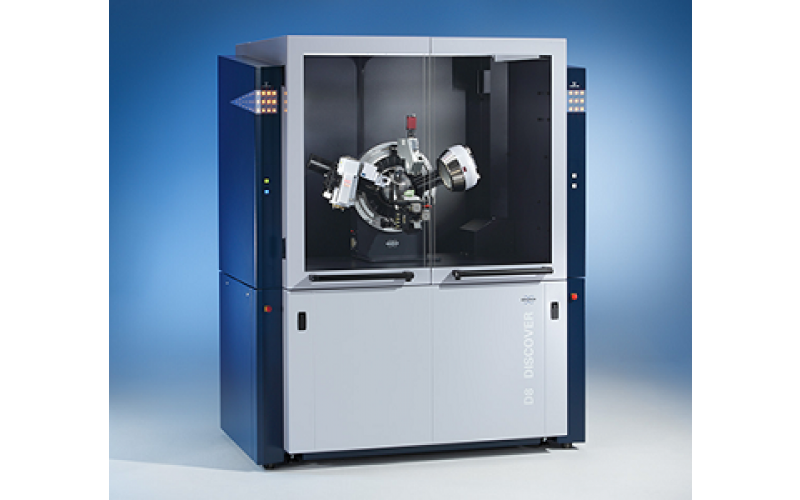
Análise de Raios-X
Difração de Raios-X
BRUKER AXS
Investigação e Ensino, Materiais
|
Especificação |
DISCOVER |
DISCOVER Plus |
|
Dimensões exteriores (altura x largura x profundidade) |
2,020 mm x 1,680 mm x 1,290 mm (79.5” x 66.0” x 50.6”) |
|
|
Peso (sem componentes eletrónicos opcionais) |
945 kg (2,085 lbs) |
|
|
Potência |
Monofásico: 208 a 240 V Trifásico: 120 V, 230 V, 240 V 47 a 63 Hz |
|
|
Arrefecimento a água |
Tubo selado: Externo IµS: Nenhum |
Tubo selado: Externo IµS: Nenhum TXE-HE: Externo |
|
Goniómetro |
D8 |
ATLAS™ opcional com braço não coplanar |
|
Reconhecimento de componentes |
Automático |
|
|
Potência do gerador |
Tubo selado: 3 kW - IµS: 50 W - TXS/TXS-HE: 6 kW |
|
|
Segurança contra radiação |
Conformidade com a Diretiva 2014/30/UE |
|
|
Segurança elétrica |
Conformidade com a Diretiva 2014/35/UE |
|
|
Segurança das máquinas |
Conformidade com a Diretiva 2006/42/CE |
|
In a coplanar experiment, the source and detector increase their angle relative to the sample surface resulting in a probing direction into the sample surface.
In a non-coplanar experiment, the source and detector angle relative to the sample surface is fixed, with the detector moving in a direction parallel to the sample surface resulting in a probing direction along the sample surface.